The XRS engine and first CVT create separate Corolla cautions
The Corolla's record is so strong that the bad years are the exception, not the rule.
RepairPal rates it 4.5 out of 5 and ranks it first of 36 compact cars, with an average annual repair cost of about $362 against $526 for the class.
Only 7 percent of repairs rate as severe against 11 percent for the class.
That baseline is exactly why a weak-year Corolla still looks tempting on a used lot, and why it pays to know the two years that break the pattern.
Across more than 20 model years, the number you really have to steer around is small, which is not something you can say about most cars this old and this common.
The trouble concentrates in just two spots, and the fault is different at each one:
Model-year risk map
- 2003-2008
- Older ninth and early tenth gen: solid cars, but high-mile and aging now
- 2009-2010
- 2.4L 2AZ-FE (XRS) burns oil, also caught in the floor-mat and accelerator recalls
- 2011-2013
- Late tenth-gen cars, dependable and cheap to run
- 2014
- First year of the CVT: low-speed shudder and hesitation complaints
- 2015-2019, 2020+
- The years to target, CVT sorted and complaints minimal
Trim identification comes before the oil warning
The 2009-2010 cars are the real avoid, and 2014 is a minor one. Everything else is the dependable Corolla people expect.
Those 2009-2010 cars also drew complaints about excessive wind noise and vague electric power steering, and this is the era of Toyota's large floor-mat and sticky-accelerator recalls, which pulled millions of vehicles back to dealers.
Those recalls have long since been remedied on any car still on the road, so the problem that actually costs real money today is the oil.
| Year or group | Starting verdict | Evidence | Required check |
|---|---|---|---|
| 2003-2008 | Consider for low cost | Durable but now age-sensitive | Rust, leaks, mounts, and maintenance records |
| 2009-2010 XRS | Avoid active oil burners | 2.4L 2AZ-FE oil-consumption history | Engine code, dipstick, smoke, and repair proof |
| 2009-2010 1.8L | Inspect carefully | Different engine from XRS, plus recall history | VIN, pedal, floor-mat, and oil checks |
| 2011-2013 | Target | Mature tenth-generation years | Normal age and service condition |
| 2014 | Inspect the CVT | First CVT year drew hesitation and shudder reports | Cold engagement and low-speed creep |
| 2015-2019 | Target | More settled CVT years | Fluid history and ordinary wear |
| 2020+ | Consider by VIN | Newer platform with a shorter age burden | Recall status and complete inspection |
The Corolla table prevents an XRS-specific issue from becoming a claim about every trim. It is not a prediction for one vehicle.
Move a vehicle forward only when its VIN, repair history, and physical condition support the row.
A cold 2014 CVT tells more than the badge
The 2014 Corolla is a much softer caution.
It launched the current CVT, and some early cars shuddered or hesitated at low speed, the kind of thing you feel creeping through a parking lot.
On the worst examples owners reported the shudder starting before the first oil change, though outright failures were rare and most cars simply drive normally.
Toyota's later software and hardware updates smoothed the worst of it out.
A 2015 or newer of the same generation sidesteps the first-year risk, so there is little reason to hunt for a 2014 specifically.
Ask for maintenance records and confirm the CVT fluid was changed on schedule, since a neglected transmission is the fastest way to turn a minor first-year quirk into a real bill.
If a 2014 shudders or slips on the test drive, walk away rather than gamble on it settling down.
2011-2013 and 2015-2019 offer different value
A Corolla decision starts with engine code and transmission behavior rather than its reputation alone.
Identify the trim, then apply the matching buy or skip signal.
The case for the good years is easy. From 2015 on, the CVT settled down and the Corolla went back to its usual pattern of almost no widespread faults.
The 2015 to 2019 cars are the mature version of the generation the 2014 launched, and the 2020-and-newer models moved to Toyota's newer platform with a stronger 2.
0L engine, so both stretches are safe used buys. Parts are cheap and every independent shop stocks them, which keeps repair bills among the lowest of any car you can buy.
Insurance and fuel costs stay low too, which matters more over a decade of ownership than the sticker ever does.
If you want a larger sedan for not much more, cross-shop a Toyota Camry or read the Camry reliability breakdown, but for a compact the Corolla is hard to beat, and it remains one of the safest picks for a first car.
Confirm engine code, recall work, and warm CVT behavior
Identify the engine before applying an XRS warning to every Corolla. The 2.
4L XRS carries the strongest 2AZ-FE oil-use concern, while the common 1. 8L needs its own condition and recall checks.
Toyota's warranty policy acknowledged excessive oil consumption reports on affected vehicles. Current buyers should rely on the engine code, oil level, and repair invoice because the old coverage period has passed.

The Corolla profile helps confirm whether the car is an XRS with the 2. 4L or a common 1.
8L model. That distinction prevents a real 2AZ-FE warning from turning into a false claim about every 2009 Corolla.
On a CVT car, test cold engagement, parking-lot creep, and steady acceleration after warmup. A smooth drive plus verifiable fluid and recall history is stronger evidence than a low odometer alone.
Compare the asking price with the wider sedan model field before accepting a premium for the Corolla name.
Check trim first, then condition:
- Confirm trim and engine code before judging oil-use risk
- Test CVT engagement from cold in Drive and Reverse
- Inspect accelerator-pedal and floor-mat recall completion by VIN
- Check for blue smoke after idle and on acceleration
- Compare the example with the Toyota model range and gas-car field
Missing paperwork does not prove that a repair was unnecessary. End the deal when engine identity, oil level, or CVT behavior remains uncertain.
Engine and transmission identity must be documented
The XRS oil warning belongs to a specific performance engine, not every Corolla of the same age. Confirm the VIN, trim, and engine code before applying it.
Ask for oil-level history and any internal engine work. A standard Corolla with a different engine should be judged on its own service record.
Correct identification prevents a narrow fault from becoming a misleading warning for the whole model line.
For a 2014 CVT car, identify the transmission and review fluid service with the correct specification. Start cold and repeat the low-speed test after a longer drive.
Hesitation, judder, rpm flare, delayed Reverse, or warning history deserves diagnosis. A recall or service action must be confirmed by VIN.
A seller's statement that "Toyota handled it" is not enough without the completion record.
Proof by Corolla version
- XRS
- Trim and engine code plus oil-level history
- 2014 CVT
- Correct fluid record, VIN work, and hot drive
- Conventional automatic
- Clean shifts and leak-free inspection
- Later Corolla
- Current campaigns and complete routine service
Build the offer from evidence and immediate wear
Corollas are often bought for low running cost, so deferred maintenance can hide behind a high reliability reputation.
Measure tire tread, test the battery, inspect brakes and struts, confirm cold A/C, and scan every module. Check for delivery or rideshare wear that the odometer alone cannot explain.
A worn driver's seat, repeated curb damage, and mismatched tires can reveal harder use.
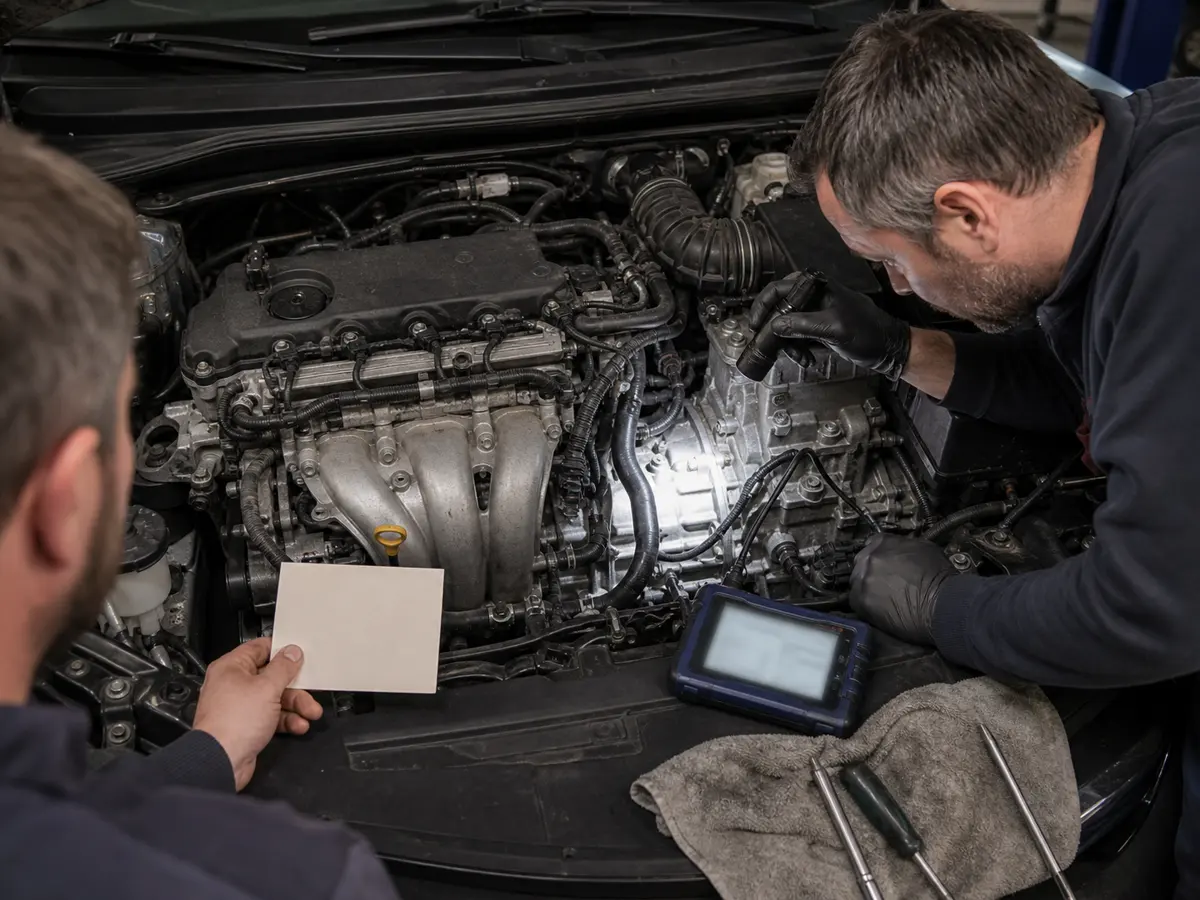
Price those visible items separately from an uncertain engine or CVT. A good-year car with normal wear may still be the better buy because the costs are measurable.
Walk away when the seller blocks engine identification, a cold start, a full scan, or a warm transmission test. Those missing checks remove the evidence needed to call the car inexpensive.
Keep the Corolla inspection narrow and repeatable:
- Decode the VIN, trim, engine, and transmission before applying a warning
- Check cold oil level and ask about top-ups between services
- Observe CVT engagement before the car is warm
- Repeat acceleration, coasting, and Reverse after a longer drive
- Scan all modules and verify current campaign completion
- Price tires, brakes, battery, struts, and A/C separately
A compression or leak-down test makes sense only when oil use, smoke, misfire, or poor running creates a reason. A CVT specialist is useful when heat reveals judder or delayed movement.
These targeted checks are better than replacing parts by guesswork. The Corolla's low running-cost advantage survives only when the exact engine and transmission pass the evidence-based inspection.
The service interval should match how the Corolla was used.
Repeated short trips, long idle periods, delivery work, and heavy urban mileage can age fluids and brakes differently from steady highway travel.
Ask the seller to explain unusually low annual mileage or long gaps in records. Then compare the explanation with seat wear, pedal wear, tire dates, and scan history.
These details do not prove abuse on their own, but together they help the inspector decide whether the odometer and maintenance story are credible.
Verify a Corolla history that looks unusually clean
A low-mile Corolla may be a strong find, but long storage and sparse records create their own checks.
Read tire date codes, test the battery, inspect brake rust, look for rodent damage, and examine fluids that age by time as well as mileage.
Confirm that registration, inspection, and service dates form a believable sequence.
A high-mile commuter can also be attractive when maintenance is consistent and wear matches the odometer. Highway mileage often leaves different evidence from delivery work or repeated urban trips.
Compare seat, pedal, steering-wheel, cargo, wheel, and tire wear with the seller's use description.
Resolve mismatches such as:
- Recent tires on a claimed stored car with no explanation
- Long service gaps followed by several repairs just before sale
- Heavy interior wear with unusually low mileage
- CVT fluid claims that do not identify specification or date
- Engine or trim descriptions that conflict with VIN data
None of these proves fraud alone. They tell the inspector where documentation is weak.
A credible Corolla history is a chain of dates, mileage, condition, and named service.
When the chain breaks around the engine, CVT, or odometer story, do not let the model's reputation fill the gap.